
Gigantic.58
Sort Of My Town

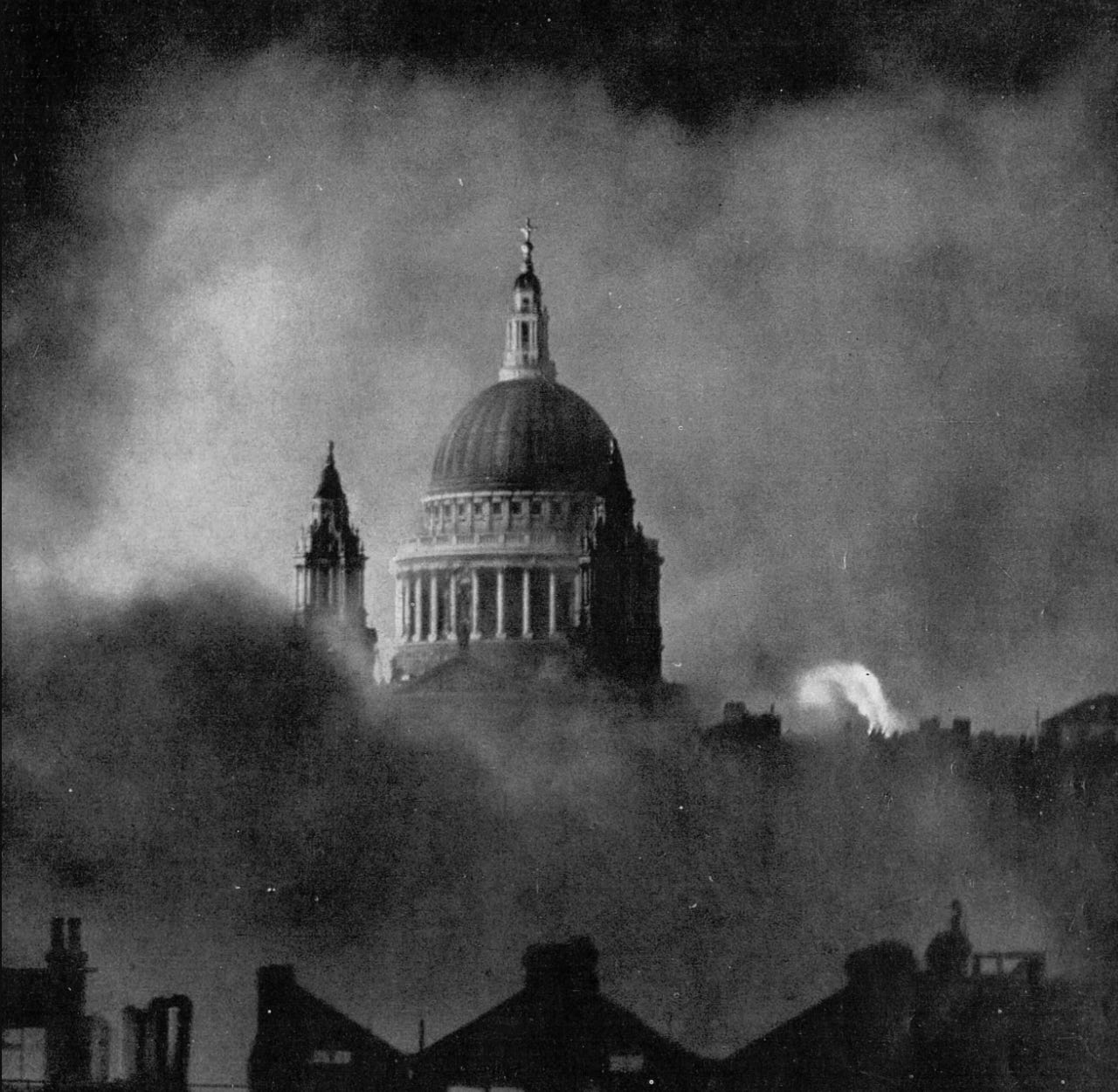
Few images are as inspiring as St. Paul’s Cathedral surrounded by black smoke, standing tall as a symbol of England’s resilience, surviving the Blitz while surrounding buildings burned during World War Two.
The previous structure was not as lucky. Dating back to the 11th century, it had fallen into disrepair. When Charles II commissioned Christopher Wren to restore the structure, Wren instead recommended the cathedral be demolished to make way for a new one.
The matter was still under discussion when the old cathedral burned to the ground during The Great Fire of 1666. Probably most of my British friends would think it a sacrilege, but the thought did cross my mind that Wren had torched the place.
The Great Fire may have destroyed London, but it did wonders for Wren’s career. Monuments, hospitals, government buildings, dozens of churches and of course St. Paul’s itself. Christopher Wren completely rebuilt the city.
We know that the fire started accidentally in a bread oven on Pudding Lane, a congested warehouse district half a mile from St. Paul’s. This is well-documented, so Wren’s reputation is safe from my conspiracy theories.
While 80% of the medieval city burned, the borough of Camden to the northwest was spared, so it’s not exactly accurate to say that any old building in Camden “survived” the fire, but you’ll sometimes still hear people say something is pre-Fire if it’s older than 1666 and is anywhere in London.
Denmark Street wasn’t even a street yet when the stables were built in 1635. The building was converted to a forge, and by the end of the 17th century it would be a part of a row of twenty houses.
The first music publisher set up shop on Denmark Street in the early 20th century. The street became known as Britain’s Tin Pan Alley. Both Melody Maker and NME were born on Denmark Street.
The old forge at 26 Denmark Street spent the 20th century as a carpenter’s shop, a storage space, and a comic book store before its transformation into the legendary 12 Bar Club in the mid 90s.
The fireplace from the original forge was part of the stage, that was a seriously cool historical/architectural detail. Less cool was the rest of the house, which defied logic. What might be described loosely as a “balcony” actually ran right up to the stage. As a performer, you were forced to divide your attention between a split-screen audience, half below your feet, the other half above your head.
The good news was that the write-up in Time Out had worked, the place was packed. When my mom and Pat arrived, the doorman let them in without even looking at his guest list.
“You must be The Mums,” he said to them.
I played with Sean and James again that night. A successful show at an insider industry-favorite venue, seemed like things were on track.
At the same time, other outings were more like buckshot.
I played a venue called Kashmir, it proved to be more of a glorified open mic night. Open mics are great, I never would’ve started playing otherwise, but at this moment in my career it felt like a step backwards.
Some friends showed up to support me, it turned out to be a good night, but Katie and I agreed it might be time to get a proper booking agent.
Afterwards, some of us were going to a party, but my mom and Pat were ready to call it a night.
“We’ll find a cab, don’t worry about us,” my mom said.
This was well over a decade before Uber, there was no way they were going to find a cab on a London side street at this hour.
“I’ll find you a cab, just wait in the bar,” I told her.
She conceded with one caveat:
“Wear a hat,” she insisted.
“Okay, Mom.”
It’s like I was eight. I pulled out an army surplus hat that my cousin Jason had given me in Brooklyn two weeks before, it’d been in my pocket since then.
Standing out on Marylebone Road, I was glad I was wearing it. It was a cold December night and the wind had picked up. I was out there freezing for about ten minutes. Of course there were no empty cabs. I was starting to give up hope.
Suddenly, someone was tapping me on my shoulder. It was my cousin Jason!
“Hey,” he said, like, no big deal.
“What the?”
He and his girlfriend Ondine were on their way into town from Heathrow that very moment. This had just literally happened:
Ondine: “J, that guy has your hat.”
Jason: “Wait, that’s Adam.”
They still had the cab with the meter running.
“Wait right here!”
I got my mom and Pat, hustled them into the cab with Jason and Ondine, who got them back to their rental flat, checked into their own place, then met me at the party an hour later.
In Christopher Wren’s time, London already dwarfed other European cities with almost half a million residents. By 1999 the metro area had exploded to something like 10 million.
The odds that my cousin would notice me riding past at 11pm on a random weeknight were statistically inconceivable, particularly right when I needed a cab the most.
But that’s sort of how London felt in those days. Impossibly vast but, after years of trying to decipher it, somehow within reach.
It was sort of my town.
—
Click below for…
It's not London -- it's you
000eeEEEee000
A terrific entry – fun, informative, and sweetly personal. Solid stuff. [Loved the conspiracy theory, naturally.]