
Gigantic.50
Lost in Translation

EATING
Lunch in Tokyo: bento boxes filled with fresh, delicious sushi purchased right on the street. I could live on these, happily. But at night the vendors disappeared, so I tried different restaurants.
First, conveyor belt sushi. It’s what it sounds like. You sit at a table or counter, there’s a conveyor belt, you help yourself to whatever looks good as it rolls past. A robot cart comes around with drinks. It was very Jetsons, and automation meant I could have a sit-down meal without having to speak Japanese, but it also felt like cheating.
The next night I took a chance with a neighborhood noodle joint. There were pictures in the window of different dishes, I took out my notebook to write down some corresponding Japanese letters to help me order, but the cook must’ve seen me through the window and took pity on me. He came outside and said something in Japanese, suggesting I should just point to which photo I liked. I did.
“Onegai shemas,” I said.
We both smiled.
There were flags with Japanese kanji printed on them hanging halfway down over the doorway. To a westerner, it seems counterintuitive to obstruct the entrance of a place of business, but in Japan it’s common to have to duck in order to go inside.
No one paid me much mind, even though I was probably the only Gaijin (non-Japanese) to come in here in months, or ever. I sat at the counter, the woman working there handed me a hot towel to refresh myself.
The place was loosely filled with tired, mostly solitary men, who’d just finished a long day’s work. Some read newspapers, some stared at their food, others watched the news on a small TV suspended in the corner.
It was steamy. Dishes clanked. The sounds and smells of cooking. Slurping. I was given a huge bowl of noodle soup, mostly cabbage, not too much seafood, but that was okay. Enough to fill two people. I ate the broth with a spoon for a while. As I picked up the chopsticks, the woman behind the counter was quick to offer me a fork, but I smiled to indicate I was okay. Again, amazement that a Gaijin could use chopsticks.
The hotel offered breakfast but it was expensive and not included. Most of the interesting-looking places in the vicinity didn’t open until 11am, which explains why one morning I found myself in a McDonald’s, but I was glad I went.
For one thing, they had one of John Lennon’s guitars on display in a plexiglass box and were playing Beatles’ music. No explanation.
Another thing was the exchange at the counter while I was trying to get some water. I believed the Japanese word was mizu, but for some reason two different cashiers could not understand what I was saying. The manager came out from the back. He was smiling, I was smiling. The conversation went something like this:
Me: Mizu?
Manager: Mizu?
Me: Mee-zoo?
Manager: Mee-zoo?
I gestured with my hand, as if drinking from a cup.
Me: Meee-zuuu?
Manager: Ah, mizu!
Cashiers: Mizu!
Me: Mizu!
Success, everyone happy, there was peace in the village. The cashier got me my water, the manager bowed to me, I bowed back to the manager.
This may seem like a small thing. But I worked at Burger King in the Hudson Valley Mall in the early 80s. The manager at Burger King treated me with contempt and most definitely never bowed to me.
Having a Japanese McDonald’s manager bow to me felt strangely momentous.
—
OBSESSIVE FANS
One morning as I left the hotel, a Japanese guy who’d been waiting outside suddenly jumped to his feet and started following me. I nodded, smiled, but kept walking. Half a block later, he still seemed to be following me. I picked up my pace. He picked up his pace.
I’m not sure what I imagined was actually going on. He looked like maybe a college kid, not exactly the sort who’d try to mug me in broad daylight, but I suddenly found myself running.
I ran varsity track at KHS. One of my remaining superpowers was that I could still leave most civilians in the dust if I put my mind to it. I kept up the pace another block or two, then stopped, turned around. The kid was some distance behind but still running in my direction. I decided to wait.
When he finally reached me, he was so out of breath he doubled over momentarily and had to put his hands on his knees to support himself.
“What do you want?” I asked him.
Looking up, almost apologetically, he extended a copy of our CD and a pen.
Jesus. He’d apparently gotten the rest of the band’s signatures already. They all came-and-went from the hotel as a pack and he’d been able to get everyone in one shot. Except for me.
Poor guy must’ve been waiting outside on-and-off for two days. He just couldn’t give up without a complete set.
If I’d had known, I wouldn’t have made him work so hard for it.
—
BUSINESS CULTURE
In addition to being tour roommates, Jeff and I often did interviews together, we bounced off each other pretty well. We met Hiroe from the label in the hotel lobby and rode in a cab with him to the V2 office.
The cab had a manual transmission with the gearshift on the column. The backseat was covered in lace, which wouldn’t last an hour in NYC. I asked Hiroe about all these stubby, blackened, deathlike trees along the streets with the ravens perched in them. He told me they were cherry blossoms that would soon explode white and pink. It sounded lovely, we were just a little too early in the season.
When we got to V2, it was very office-like. In London, even though they were working, it was very jovial. Here it was all business. They put us in a room with a translator and we started doing interviews.
For the most part they were very serious, but the last interviewers were a couple of western guys who ran an English-language music magazine, they were a lot more freewheeling. I was telling them how the housekeeper back in the hotel vacuumed concentric circles around our laundry.
“Our room is like a Zen sock garden,” I told them.
We were all cracking up, which seemed perfectly normal to us, but Hiroe opened the door and looked in with a concerned look on his face, like he couldn’t understand why we were laughing at the office.
After Jeff and I were finished, the V2 receptionist thanked us and said goodbye. That was strange to us. In London, if we were at V2 doing interviews, when we finished, there’d always be someone who’d take a break to buy us a drink or something, even if it were the middle of the day.
In Japan, when it was time to socialize, for sure the people from V2 were as sincere and friendly as can be. In the work environment, it was straight-up work, and that was that.
Westerners marveled at the “economic miracle” in Japan as if it were some kind of magic trick or dumb luck. I think the secret might be something like this: they just work really hard.
—
EX-PATS
In the US, I’m maybe a couple of inches taller than the national average. In Sweden, I’m a midget. In Japan, I could play center on a semi-pro basketball team.
Everywhere I walked I was a full head taller than almost everyone else. One afternoon on a particularly long stretch of sidewalk I saw another head floating above the crowd, coming toward me. This was the first westerner I’d seen all day, which was strange enough, but what was weirder was the informal way he spoke to me from the get-go as if he already knew me.
“How long you been here?” he asked
“About a week.”
“What are you doing?”
I was well-practiced at vague, noncommittal responses, but his directness almost threw me for a second.
“Just, you know, playing some music.”
The next question at this point would often be “Are you in a band?” or something like that, but he was already past that.
“I’ve been here six months,” he said, which sounds like a simple statement of fact, but the way he said it, the subtext seemed to be he was going out of his mind and desperately needed to talk with another westerner, any westerner.
He told me a little about what he was doing for work, then:
“Hey, what are you doing right now? You wanna grab a coffee?”
Oddly, it would be very much like me to grab a coffee with a random person in a foreign country. He didn’t seem like a bad guy, but my instincts told me if we got a coffee I’d never get rid of him.
“Uh, I sorta have to get back to my hotel…”
Tokyo for me was a land of wonder. Each day, things were revealed that suggested whatever I thought of as social reality could be constructed quite differently.
Meeting this guy on the street was the first time I wondered if there could be a tipping point, where you lose the trail of breadcrumbs that brought you here, and you really just need to find your way back home.
—
SHRINE
Other random Americans drifted into our sphere. A couple of young filmmakers named Ondi and Dave from LA connected with us somehow. They seemed to know their way around, so Justin, Paddy and I joined up with them and did some poking around.
At the train station, you bought your ticket from a machine where at the end of the transaction a cartoon video image bowed to you.
“Don’t bow to the machine,” Justin said to me.
“It just bowed to me,” I said.
On the platform, men wearing white gloves would gently but firmly pack people into train cars to get the maximum number onboard and make sure the train left on time.
We were only going two stops to Takeshita Street in Harajuku, which was known to be a trendy shopping district. We saw a lot of that childlike street fashion, Hello Kitty and whatnot, that has subsequently spread across the globe, but then this seemed to be the epicenter.
Harajuku was a good place to grab more souvenirs for friends back home, buy cds, take goofy photos in photo booths. It was pretty crowded. After a while I thought it might be nice to duck into what I thought was a park, but it turned out to be much more.
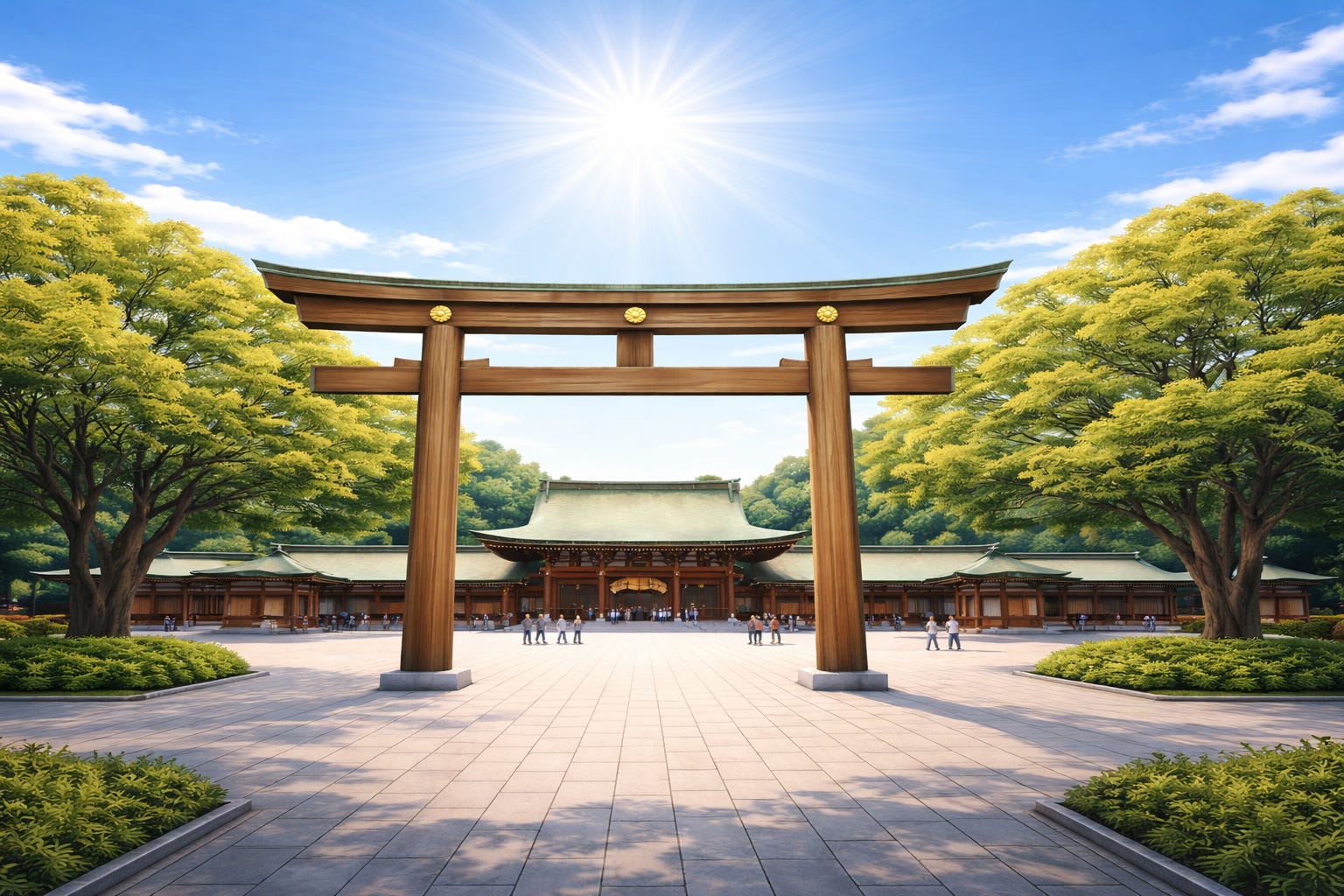
The trees were sinuous but with thick trunks, they looked like they had been there a long time. Passing under some seriously gigantic Torii gates, we found ourselves at the Meiji Shrine, named for one of the last emperors of Japan.
Much of the architecture I’d seen in Tokyo had been Japanese interpretations of what you’d find in the west, which was often taken to the next level and interesting. At the Meiji Shrine, we were finally immersed in a completely Japanese universe. Massive, overhanging roofs, unpainted wood, vague boundaries between inside and out.
As much as it’s a tourist destination, it’s also an actual Shinto shrine. We watched people washing their hands with wooden cups, so we did what they did. I found some additional instructions in English about the proper way to greet the shrine. You were meant to bow twice, clap twice, then bow again, so I did this too.
Inside the shrine wasn’t exactly a rock garden, but there were two squares of thickly raked gravel. There was also a wedding procession taking place, everyone was wearing traditional kimonos. It was something to see.
Back outside we bumped into Jeff, Jay, and Jack, who had found their own way here. It was the closest thing to a band field trip we’d had since we’d gotten here, which felt good. And while it wasn’t exactly the Buddhist temple I imagined I was looking for, it more-or-less did the trick.
—
STREET MUSICIAN
My explorations of in Tokyo were incredibly satisfying and, in many ways, things with the band were going incredibly well. I mean, we’d made it to Japan.
Still, there were things below the surface that wouldn’t go away. It wasn’t like four years earlier in Europe when I was messed up and losing it. But, since then, I’d sort of pieced together a band persona that let me get along, for the most part, but it didn’t feel like me.
Like that guy I’d met on the street who’d stayed a bit too long and lost himself in Tokyo. I’d lost myself in a band.
Our last night in Tokyo before heading to Osaka, I took a final nighttime walk around Shinjuku. It’s common knowledge the district’s aesthetic had inspired Blade Runner. It didn’t seem quite as dystopian as that, but it did get really seedy at night, neon love hotels, aggressive hawkers trying to lure you into clubs.
It didn’t help my mood to move through a place that fascinated me during the day but turned dark and twisted at night.
I was about to turn back, but decided to go just a little further to a pedestrian tunnel where the day before I’d seen a street musician playing his guitar in synch with a passing train, it’d been really inspiring.
That guy wasn’t there, of course, but there was a different musician who also caught my attention, as well as a few other people who stopped to listen to him.
He was wearing a knit cap with a pompom on top almost the size of his head. Nodding left and right, the pompom bobbed roughly in synch with his strumming. It was really simple, but there was real showmanship in it, and the guy was singing his lungs out.
When he finished the song, I approached to talk with him. I bought a cassette from him, which he had wrapped in cellophane on a small paper plate and included a napkin and small plastic fork, as it to say:
“Here, eat my music!”
It was so amazingly cool that I bought a second one to give to my friend Neil who I knew would love it.
Something about his homemade cassette and his performance reminded me of a Japanese version of what I was doing back in Iowa City with my HBO Special, before all this professional music business, when it was all just for fun.
I wasn’t sure this guy was ever going to get famous.
But it seemed like he was on the right track.
—
Click below for…
Man, you packed several installments into one sparkling entry here... It hit the sweet spot. And the line “Don’t bow to the machine" shall remain my motto from now on.