
Gigantic.41
London Lighthouse

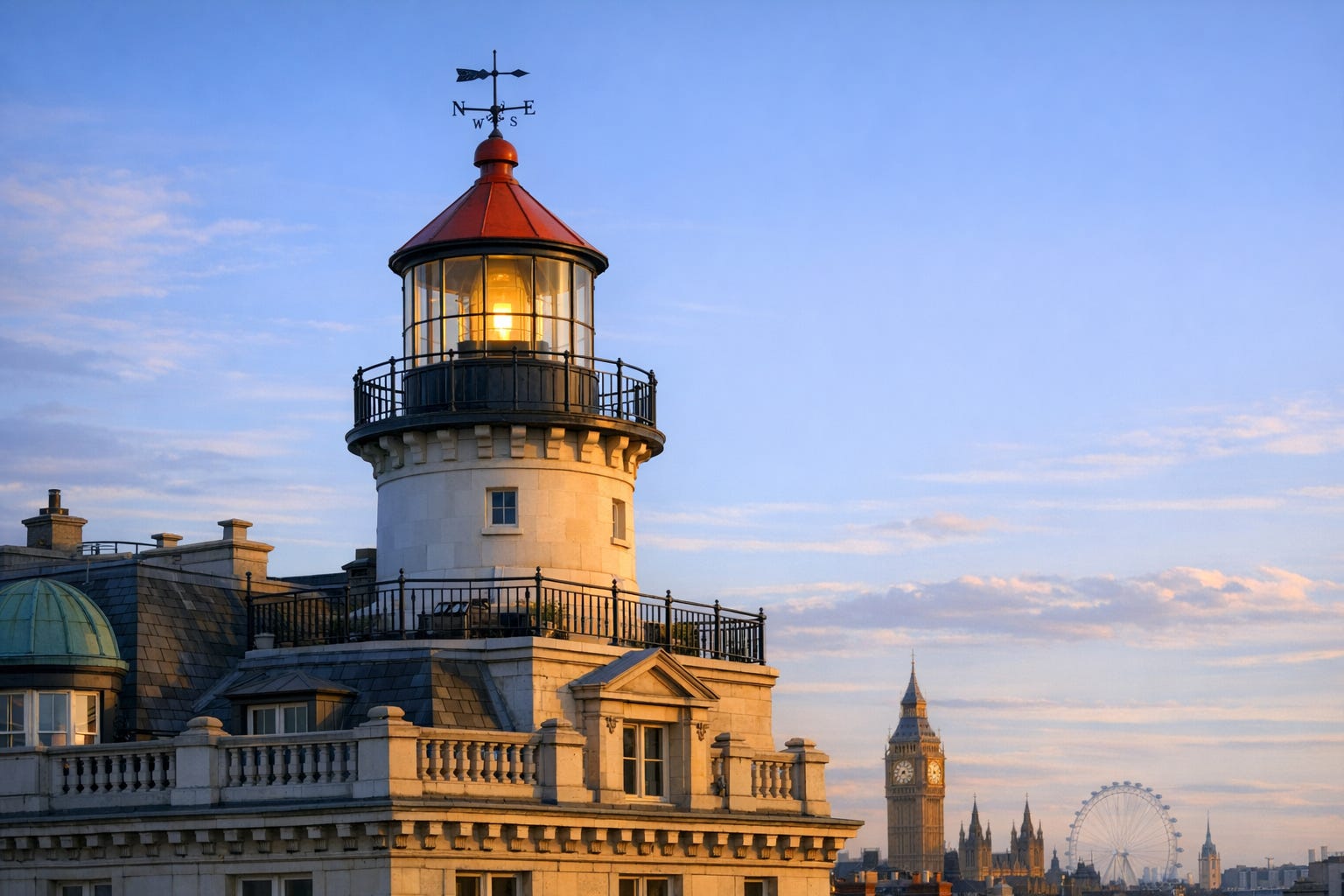
The flight to London was the first time I remember having my own little TV mounted into the seat ahead of me. Watching the flight map in real time was a novelty, and also maybe a little reassuring, since otherwise I was flying into uncertainty.
My friend Ian had left a message for me in Kingston, that he was terminally ill and wanted to see me. I’d seen him just two years before when we’d played London and he’d seemed fine. We’d gotten drunk one night and he insisted I drive his Citroën around north London. Another afternoon, I’d visited the school where he taught and played music with his students.
When I got Ian on the phone, he explained how he’d gone on holiday and ran out of meds, that he’d been HIV positive all these years but now had AIDS. He had this idea that I would come over and we’d travel Europe together. He was making partial sense. I didn’t fully understand yet that he was dealing with the onset of dementia.
A grand tour of The Continent wasn’t going to happen, but I could certainly get to London. I found a relatively cheap flight and called Ian to confirm, but he’d stopped answering his phone and I couldn’t find him anywhere.
I sent the first email of my life to my friend Katie in London who said not to worry, she was on it. A day or so later she got back to me, she had tracked him down to London Lighthouse, a hospice. I went ahead and booked the flight.
Katie picked me up at Heathrow and drove me back to her flat in Islington. I hadn’t slept yet but got on the tube and headed to Ladbroke Grove, my old stomping ground as a student in 86.
The San Remo Cafe was gone, the place I used to get beans-on-toast and instant coffee, but Royalty Studios where I’d taken art classes was still there, coincidentally right next door to London Lighthouse.
I’m not sure what I was expecting, but the London Lighthouse was a remarkable place. Well-designed, with wooden floors and nooks here and there, comfy couches, a cafe, fantastic people working there.
Ian’s room was nice and private. He looked well, his hair uncharacteristically uncombed but other than that looked as usual. We smiled and talked and talked. He had a few facts wrong. He thought we’d been flatmates just three years before but it’d been nearly twelve. Information seemed to go in loops in his brain. He was still talking about us heading to Greece as soon as he got out.
I made us some tea, exactly as Ian had once taught me, making sure to warm the pot first with a bit of hot water before you fill it all the way.
Out in the hallway, I was able to talk with his nurse to begin sorting things out, then Kate arrived, who I’d known back in the day. In addition to being a friend, Kate was a doctor. She’d been aware of Ian’s situation for some time and had been helping with his care.
Kate and I sat down together and she explained with precision the implications of dementia etc. and the certainty of Ian’s death.
The description in my journal reads:
“She saw that I was being strong for Ian’s sake but that I was inwardly upset.”
This seems like an understatement at best. It’s true I was keeping it together, but I seem to recall being beside myself.
The following day, they helped me bundle Ian up so I could push him in a wheelchair around Portobello. This was especially poignant. The two of us used to come to this market every Friday morning. It was the one day Ian would drive us in his little Fiat. We’d get Portuguese coffee and sweet bread. He’d found me my little stovetop espresso maker for only a pound, I’ve been using one like it every day ever since.
The coffee pot and how to make proper tea are just two examples. Nina Simone, fromage frais, Saint-Émilion, Doc Martens, church at St John’s Wood on Sunday mornings. So many things that helped inform who I was becoming came from Ian.
When I’d marveled at the full case of red wine he kept under the kitchen table, he’d said:
“Adam, if I can’t have wine with my dinner every evening, it’s simply not worth living in London.”
When I’d showed up to the flat with a block of cheap farmer cheese, explaining it was all I could afford:
“Adam, when we don’t have money, we still buy the best cheese, just less of it.”
When I’d added strawberry yogurt to a pasta dish, and he ate it anyway:
“Adam, usually we don’t mix the sweet with the savory.”
Over the first couple of days this trip, I connected with several of Ian’s other friends who also came to visit him at London Lighthouse. It was good to see there was a loose network of people looking after him, and we all exchanged numbers so we could stay in better touch.
The third day I went to visit thinking I would try to take Ian out to dinner, but there were caregivers in his room when I got there, and his nurse took me aside and told me they believed he’d just had a stroke.
I sat with him for several hours while waiting for the ambulance. The times he tried to speak it was garbled. Some other friends came and went, but somehow it was me who rode with him in the ambulance and stayed with him continuously for what felt like the longest night of my life.
There was so much waiting at the hospital, and when we weren’t waiting there was a stream of doctors and nurses who poked and prodded. Honestly, none of them seemed to have the slightest idea what they were doing or what was wrong with him.
At one point when they’d left us alone, I was looking at Ian who was writhing on the gurney. It seemed he was going to check out right then and there, when he suddenly points at me and manages to say clearly, “You!”
There was a sacred medallion he always wore, maybe it had the Blessed Mother on it. They had taken it off while they were examining him. Somehow I intuited that what he wanted was for me to put it back on him.
The whole room was glowing, pulsing. I had to lean right over him to reach behind his neck. My fingers fumbled with the tiny clasp, such a small but impossible task, but once it was fastened and the chain was secured, it seemed like everything was put right. Ian leaned back, at rest, began to breathe normally again. The glow dissipated and we were back in a sterile hospital room.
At 5:30 am we got into another ambulance and went to another hospital. But at this one they knew what they were doing. A young man with fabulous hair got Ian tucked in under warm, comfortable blankets, in a big room where other patients were similarly nestled and dreaming like babies. After being shuttled around all night it seemed like heaven in that room. I whispered goodnight to Ian, hit the street, and somehow found my way back to Katie’s.
——
When I went back the next afternoon, the doctors explained that Ian had had a series of fits, that he’d awoken briefly in the morning, but was not waking up now. I sat with him. After about ten minutes, he did wake up and, amazingly, his speech was actually clearer than the day before. Even though the dementia was still present, we were able to talk.
The next day I visited him again, and again we were able to speak. It seemed like I’d known what to say all week, but this was my last visit, and the one thing I didn’t know how to say was goodbye.
But, to paraphrase, the life force was strong with that one. Ian moved back to Northern Ireland and lived with his parents for another two years. I wrote to him regularly, and was able to have a lovely visit with the three of them one afternoon. Ian was in great spirits, and quite excited to talk with me about the books he’d been reading.
I can’t imagine how incredibly hard those two years must’ve been on his aging parents, but at the same time, I knew that they were glad for the time with him. For me, it was beyond comforting to see him at home, and at peace.
——
Other than the night in the emergency room, I’d wound up going out quite a bit while I was London. Katie’s hubby, Sean, was a club promoter. I wasn’t drinking, but the scene was pretty electric, and going out took my mind off things temporarily.
I hung out with a few friends I hadn’t seen in a while. Also, I wound up going out for coffee with Katie and a few of her friends who were in the music business.
One of them worked at a label, she seemed very interested in talking with me. I’ve never been good at schmoozing, and with the mindset I was in at the time, double that. But despite my reluctance to discuss my music, or maybe because of it, she was intrigued. She gave me her address.
“Send me your demo,” she said.
I tucked her address away somewhere. My head just wasn’t in the game.
But it was a long flight home, it gave me time to think.
I’d been talking on-and-off with Jacques Cohen in Poughkeepsie about doing a demo, or some such thing. Shortly after I got back to New York, I gave Jacques a call.
“Let’s do it.”
It’s funny, thinking back on it. I’d gone to London to see Ian, plain and simple, and predominantly that’s how it remains in my memory. But it was also this trip, unintentionally, that planted the seed for what would grow into my solo career.
—
Click below for…