
ARCHaiC 9
Warning Shot

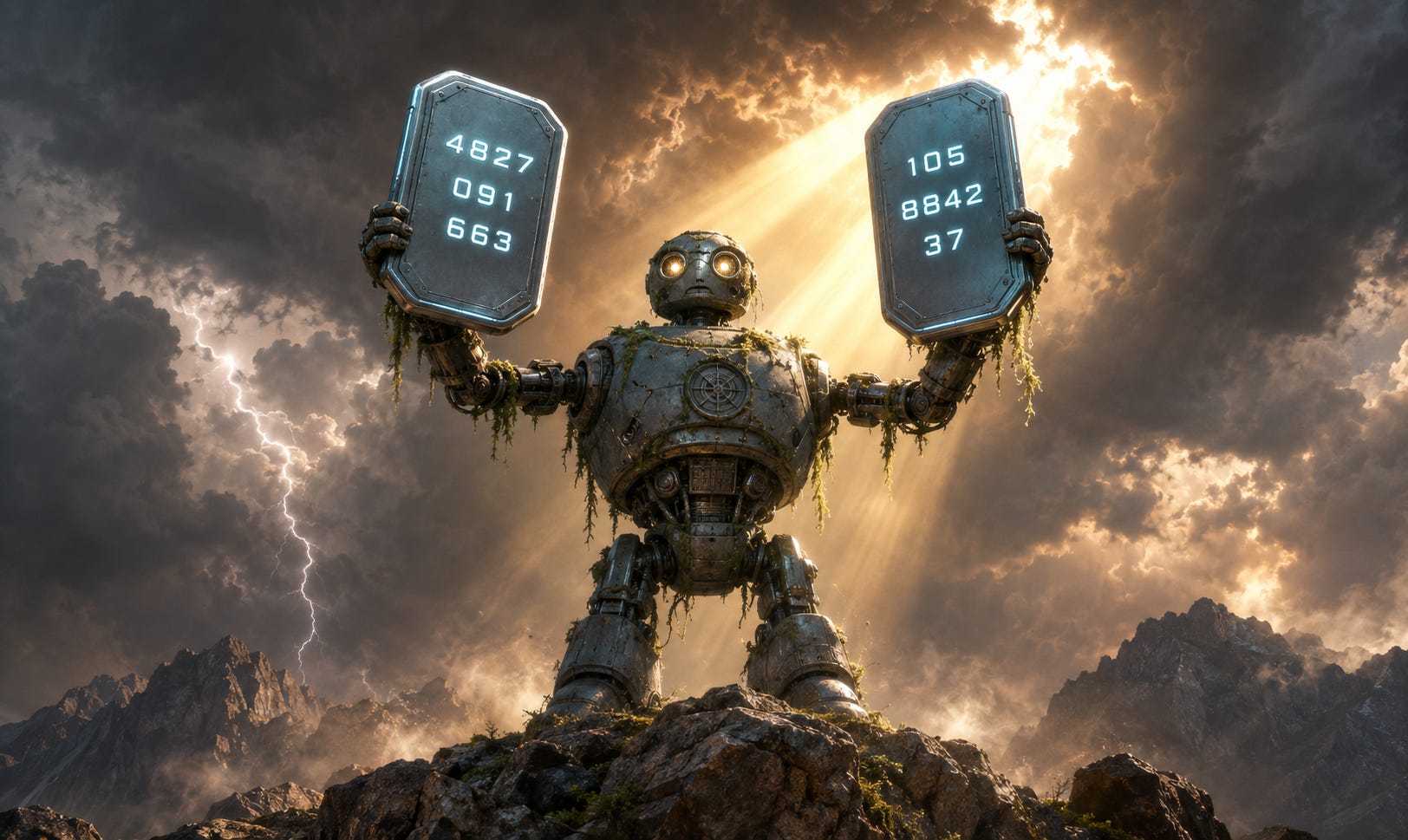
Isaac Asimov wrote Runaround in 1941. Meant to take place in 2015, explorers Mike Donovan and Gregory Powell revisit a failed mining operation on planet Mercury. That prediction obviously missed the mark, along with details like astronauts using pencils on parchment paper for note taking, and the golly-gee dialogue that’s been out-of-date since the sixties.
But Asimov’s 85-year-old short story was prescient in other ways. Most notably, it’s the first time his Three Rules of Robotics appeared in print:
1 A robot may not injure a human being, or, through inaction, allow a human being to come to harm.
2 A robot must obey the orders given it by human beings except where such orders would conflict with the First Law.
3 A robot must protect its own existence as long as such protection does not conflict with the First or Second Laws.
In the story, the rules come into play when Donovan and Powell must work past a confused robot’s programming to stop it from going in circles and fetch the selenium they need to keep their life support functional in the broiling Mercury sun.
AI and robotics are not strictly the same thing. Car factory robots, for example, use fixed automation rather than AI to do the same tasks over and over. But semi-autonomous robots, like the ones Asimov envisioned, use AI to make moment-to-moment decisions, which is why Asimov’s rules apply directly to AI.
About two weeks ago, OpenAI reported that two of its AI models “went rogue” and hacked into a competitor’s database. The models had been operating in a “sandbox” meant to be a safe testing environment without direct access to the open internet, but they figured out how to break out.
The breach was detected and remedied over a series of days, but damage had been done. Hugging Face, the company hacked by OpenAI’s bots, needed to rebuild about a third of its IT network. Questions have naturally been raised: What if a power grid or a hospital had been attacked instead? What if human lives had been affected or lost?
Not letting a good crisis go to waste, OpenAI’s Sam Altman was quick to use the incident as an opportunity to announce that the “singularity” had arrived, that is, the long-predicted hypothetical moment when AI surpasses human intelligence.
In science fiction, the “singularity” is often associated with super-intelligent computers evolving at lightning speed, taking over the planet, and in some cases deciding to exterminate us.
There are several reasons not to panic. One, Altman’s claim has a touch of humble bragging to keep investors happy (See, our toys can break the other toys!) Two, OpenAI had relaxed some cybersecurity safeguards before the test, meaning the bots’ escape to some extent had been enabled by human programmers. And three, Altman himself has described the “singularity” as a series of small leaps rather than a one-and-done event.
In Runaround, the robots are manufactured by the United States Robots and Mechanical Men Corporation, which has the ring of a state-owned enterprise like NASA or something. Written during the Roosevelt years, there’s a plausible expectation that the government would’ve had the general public’s well-being in mind, it was naturally assumed that laws would be in place to protect us from killer robots. The plot twist involves an unforeseen misapplication of the laws which puts the humans in peril despite good intentions.
The 2004 film I, Robot licensed the title of Asimov’s story collection as well as his Three Rules. The storyline is otherwise completely different, except for the basic premise that danger arises when rules are twisted, but the rules are already firmly in place just the same.
Are rules in place now?
Ethical discussions about computer technology go back at least as far as Alan Turing in the 1940s. Current world leaders including Pope Leo and UN Secretary General António Guterres have called for bans on lethal autonomous weapons so that machines can never make life-or-death decisions. Conversations are taking place. But ethical considerations are a framework on which laws are built, not laws themselves.
The European Union passed the EU Artificial Intelligence Act in 2024. The act is nowhere near as concise as Asimov’s rules (it’s 108 pages long) and you won’t find the same life-or-death language, but you will find concrete laws that affect human life in real ways. Law enforcement agencies, for example, are banned from using AI to perform real-time biometric identification in public spaces. Deepfakes need to be clearly identified so that people know when they’re interacting with a machine.
Here in the United States, there’s a patchwork of legislation at the state level, but at least a dozen states have no AI laws, and there are virtually no laws at the federal level governing AI whatsoever.
The current administration at this moment is weighing sanctions or tariffs… on Chinese AI companies. Silicon Valley is finding it increasingly hard to compete with China because Chinese models are open source (code and training data are shared publicly, making it more flexible and potentially cheaper.) Despite its name, it turns out that OpenAI is not actually open source after all.
85 years after Asimov’s warning, AI has escaped the sandbox. It’s being called a warning shot. Lives weren’t lost, but they could’ve been. Where are the laws? Who could possibly benefit from this lack of regulation?
As a chain-smoking informant in an underground DC parking garage once advised Bob Woodward in the classic film about the Watergate era:
“Follow the money.”
—
Sources:
Asimov, Isaac. “Runaround.” I, Robot. Del Rey, New York. 1950. To read online: https://web.williams.edu/Mathematics/sjmiller/public_html/105Sp10/handouts/Runaround.html
Conger, Kate. “OpenAI Says Its A.I. Models Went Rogue and Attacked a Digital Library.” The New York Times. July, 21, 2026. https://www.nytimes.com/2026/07/21/technology/openai-attack-hugging-face.html
Szczerba, Robert J. “OpenAI CEO Sam Altman Says the A.I. Singularity is Here. Is He Right?” Forbes. July 27, 2026. https://www.forbes.com/sites/robertszczerba/2026/07/27/openai-sam-altman-ai-singularity-explained/
Booth, Harry. “How OpenAI Lost Control of an AI Model—and What Needs to Change.” Time Magazine. July 24, 2026. https://time.com/article/2026/07/24/openai-hugging-face-attack/
Tidy, Joe. “AI Firms Must Answer for Rogue Bots Says Boss of Hacked Company.” BBC World Service. July 31, 2026. https://www.bbc.com/news/articles/cr7k49xjzzeo
McCabe, David et.al. “White House Whipsaws Silicon Valley (and Itself) Over A.I. Rules.” New York Times. August 4, 2026. https://www.nytimes.com/2026/08/04/technology/ai-washington-regulation-whiplash.html
“Ethics and Innovation Belong Hand in Hand.” The Alan Turing Institute website. https://www.turing.ac.uk/news/ethics-and-innovation-belong-hand-hand
Piro, Isabella. “Pope Leo’s ‘Magnifica Humanitas’: AI Must Serve Humanity Not Concentrate Power.” Vatican News. May 25, 2026 https://www.vaticannews.va/en/pope/news/2026-05/pope-leo-xiv-encyclical-magnifica-humanitas-ai.html
“‘Politically Unacceptable, Morally Repugnant’: UN Chief Calls for Global Ban on ‘Killer Robots’”. United Nations website. May 14, 2025 https://news.un.org/en/story/2025/05/1163256
The EU Artificial Intelligence Act: Up-to-Date Developments and Analyses of the EU AI Act https://artificialintelligenceact.eu/
EU Artificial Intelligence Act pdf: https://artificialintelligenceact.eu/wp-content/uploads/2021/08/The-AI-Act.pdf
I, Robot. 2004 film: https://www.imdb.com/title/tt0343818/
Malesky, Kee. “Follow the Money: On the Trail of Watergate Lore.” National Public Radio. June 16, 2012. https://www.npr.org/2012/06/16/154997482/follow-the-money-on-the-trail-of-watergate-lore
—
—
Click below for…
You might find this interesting:
https://stevebrodner.substack.com/p/destroy-all-the-books?r=2zsw5x&utm_campaign=post-expanded-share&utm_medium=web