
ARCHaiC 7
Data City

Returning to California to find her childhood home was gone, Gertrude Stein famously said, “There is no there there.”
The AI universe feels like it meets this description. Disembodied. Untouchable. Floating, as they say, in a Cloud. But there is very much a there. And a there, and a there, and maybe soon a here depending on where we live.
There are over 4,000 data centers in the United States with thousands more being planned or built. Every time we interact with AI, our questions are being processed physically by thousands of GPUs (Graphics Processing Units) each containing billions of microscopic transistors flipping on-and-off at lightning speed.
Even if we’re not chatting with a chatbot, if we’re streaming shows or music, or saving photos somewhere other than on our own devices, we’re interacting with data centers.
Data centers go back as far as the 40s when early mainframes needed to be maintained in climate-controlled rooms. The internet boom in the 90s required centralized servers which gave birth to the data center industry, which would eventually explode to meet the needs of the AI Era.
There are small-to-medium data centers that can handle small enterprises and municipalities. Average ones are about 100,000 square feet and can rent processing space to multiple businesses or a single large corporation. Then there’s hyperscale for companies like Meta and Google, each over a million square feet.
In addition to eating up hundreds of thousands of acres that used to be farmland, data centers exist physically in other ways as well.
All those servers require enormous amounts of electricity to keep their microscopic transistors flipping. This generates a tremendous amount of heat, which requires constant cooling, which requires even more electricity.
Where does the energy come from? Sometimes the grid, which can translate to higher rates for the general public, which means we’re basically subsidizing the infrastructure improvements for big data.
Some data centers, particularly hyperscale ones, build their own on-site power plants. There’s talk of zero-carbon in the future, but for the moment, most power generation still relies on fossil fuels, which means a big uptick in carbon emissions, and breathing challenges for people who suddenly find themselves living next to a data center with on-site generation.
Cooling also requires water, almost half a billion gallons per day total across the US. Well over half the data centers are located in places where water scarcity is already an issue, but this level of usage can also put a strain on systems where water usually isn’t a problem. Where will the water come from?
The race is on to build more centers due to increased demand, competition between tech corporations, and geopolitical competition with other countries like China.
Tech companies are also building to the max before regulations catch up with them, one reason NY State Governor Kathy Hochul last week signed the nation’s first moratorium on building new data centers. The moratorium lasts a year, which will pass quickly, but it buys NY legislators time to respond to constituents’ concerns and to figure out how to regulate.
Also in the news, Anthropic is in talks to lease computer power from Meta (i.e. Facebook.) What does this mean? Did Meta build too many data centers already? Is Anthropic not building enough?
Seemingly unrelated stories are often related, the continued pressure to acquire Greenland, for example. Open spaces, freezing temps, rare earth minerals, sparse population, untapped hydroelectric…a hyperscale fantasyland.
Tech oligarchy and further environmental collapse aside, we lean into our imaginations and take a tour. We behold for a moment without judgement the sheer spectacle of The Data Center…
Past adjoining neighborhoods where particulates settle on clotheslines, and dusty yards resonate with a constant low-frequency hum. Along a 12-foot fence made of anti-climb mesh, topped with razor wire.
Through the guard gate, one place we will most definitely find a human being, who will check our ID and make sure our visit has been pre-approved before handing us our temporary ID badge.
The parking lot, having been built to handle the construction phase, seems ridiculously large considering there are only 25 cars here now, but the solar panel canopies over the hundreds of empty spaces are still functional, so the space isn’t entirely wasted.
We approach a two-story warehouse-like building where there’s a second security checkpoint. We’re just visitors, so we’re assigned an authorized escort who must keep us within his sight at every moment. Even a pre-vetted technician would require an escort if he/she doesn’t actually work here.
We’ve heard some data centers have lobbies or conference rooms. This one is all business. After the second security check is an airlock with two bulletproof glass doors. The first has to close behind us before the second will open into a secure corridor, the final buffer zone before we’re admitted to the inner world of the data center.
We’re wearing anti-static shoe guards and safety glasses. They’ve let us keep our phones as long as we don’t take photos or videos. But they’ve confiscated our half-eaten bag of trail mix, as well as our notebook because it has a cardboard cover, which isn’t allowed because it’s a fire hazard and somehow releases fibers that can clog high-speed cooling fans.
We’re also wearing earplugs because it’s really loud in here. A constant 75-85 decibels, somewhere between a vacuum cleaner and a leaf blower.
“Feels like we’re at a Who concert!” we joke to our security escort, whose name is Horace.
Horace motions with his hand by his ear that he can’t hear us, but it’s just as well, he’s probably too young to get the reference.
The data center has “cold aisles” on the intake side of the humming servers and “hot aisles” on the exhaust side. We’re in a “cold aisle” so it’s a good thing we’re wearing layers.
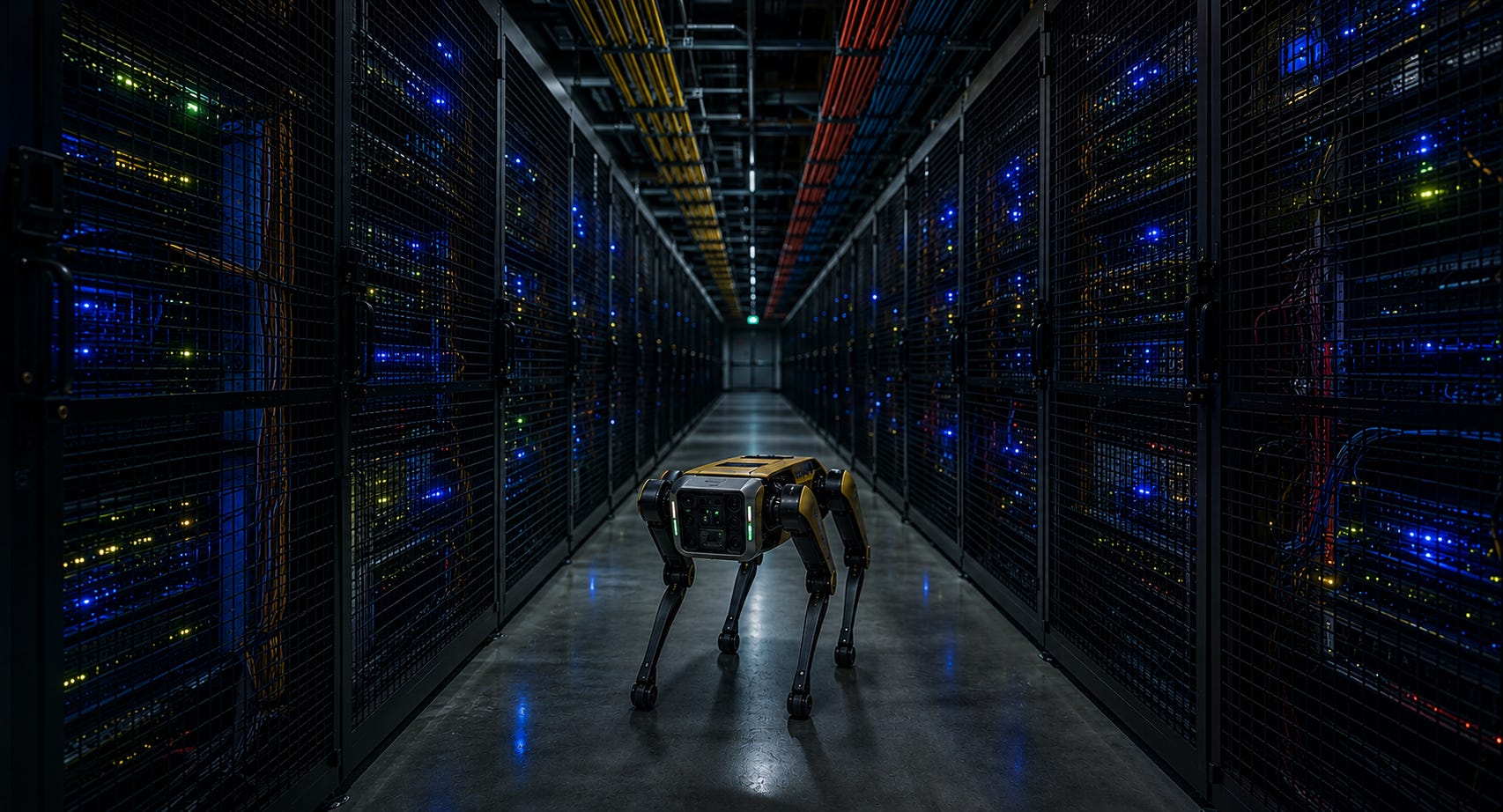
The servers themselves are installed within endless series of racks and cabinets all locked behind cages, though we can see them churning away. Above us is an overhead cable system. More wires snaking along than we can count, but they’re all color-coded so techs know what’s what.
There are no windows in the data center. Glass would admit light and glare, make temperature and humidity harder to regulate, and pose a security risk. It was daytime when we came in, but it could be day or night, there’s no way to tell.
The lighting is all high-efficiency, low-heat LEDs, which create a neutral/cool color temperature. Smart controls sense our presence and make sure our hallway is lit, but this is a “dark” center. If we weren’t here the overheads would go off and the only light would be the ambient glow of the blinking status LEDs coming off the servers.
The air quality is slightly dry. Because of all the electrical discharges, there’s a slight ozone smell, sort of like the scent in the night air right after a thunder and lightning storm.
We’ve not seen any other humans on our tour, but we do a double take when a robot security dog walks past and looks us right in the face to check that we’re supposed to be here.
The server aisles all look much the same. The service corridors have some variation, with elements like fan walls and the like. There are some additional utility areas Horace hasn’t taken us into, but we’ve seen enough for today. We’ve literally walked for miles.
The data center seems empty, yet the servers have an undeniable presence. Through the endless banks of processing units flow millions of encoded interactions per second with unseen beings, like synapses firing.
Like thoughts. Like dreams. Like ghosts.
Once we pass back outside through security, we marvel at the cooling towers, various other buildings, and the power plant we still haven’t seen yet. We might not be able to see it all in one day.
The Stargate Data Center in Abilene Texas will be one of the biggest and will cover over 1,000 acres once it’s completed. At its peak in the 5th century BCE, the urban area of Athens covered about 370.
Energy-wise, Stargate will have an operational capacity of up to 1.2 gigawatts, which is akin to something like every housing unit in Brooklyn.
We have not just toured a data center. This is a futuristic city.
But the future is happening right now, right at the edge of what we think of as our town, but we’re also disembodied citizens of the Data City. Thanks to a sort of digital telepathy, we spend hours there every day.
Yet most of us will never see it.
—
Sources:
Leppert, Rebecca. “What We Know About Energy Use at U.S. Data Centers Amid the AI Boom.” Pew Research Center. Oct. 24, 2025 https://www.pewresearch.org/short-reads/2025/10/24/what-we-know-about-energy-use-at-us-data-centers-amid-the-ai-boom/
“What Is a Hyperscale Data Center?” IBM Think. https://www.ibm.com/think/topics/hyperscale-data-center
“What is a Data Center?” IBM Think. https://www.ibm.com/think/topics/data-centers
Glenn, Mike. “Inside a High-Performance Data Center: Compute, Storage and Networking.” Equinix Interconnections. Oct. 8, 2024. https://blog.equinix.com/blog/2024/10/08/inside-a-high-performance-data-center-part-1-compute-storage-and-networking/
Coyer, Cassandre. “Data Centers Confront Rising Cyber and Physical Security Threats.” Bloomberg Law. Apr. 30, 2026. https://news.bloomberglaw.com/privacy-and-data-security/data-centers-confront-rising-cyber-and-physical-security-threats
Ashford, Grace. “New York Enacts Nation’s First Statewide Moratorium on Data Centers.” New York Times. July 14, 2026 https://www.nytimes.com/2026/07/14/nyregion/new-york-data-center-moratorium-hochul.html?searchResultPosition=3
Penn, Ivan. “Data Centers to Add Billions in Power Costs in 13 States.” New York Times. July 14, 2026 https://www.nytimes.com/2026/07/14/business/energy-environment/pjm-electricity-prices-data-centers.html?searchResultPosition=4
Tan, Eli and Isaac, Mike. “Meta in Talks to Lease Computing Power to Anthropic in Potential $10 Billion Deal.” New York Times. July 17, 2026 https://www.nytimes.com/2026/07/17/technology/meta-anthropic-ai-computing-power.html
Hanson, Joe and Schiffman, Mimi. “We Saw What AI Data Centers Don’t Want You to See.” PBS Terra. June 2026 www.youtube.com/watch?v=5p426fSlYH4&t=28s
Data Center Map: https://www.datacentermap.com/usa/
“The Environmental Impact of Data Centers.” STAX Engineering Website. Jan. 9, 2025. https://www.staxengineering.com/stax-hub/the-environmental-impact-of-data-centers/
Nicol-Schwarz, Kai. “A Former Trump Official Wants to Build a Massive Data Center in a Remote Corner of Greenland. Will It Work?” CNBC. Jan. 23, 2026. https://www.cnbc.com/2026/01/23/greenland-data-center-trump-greenmet.html
Amos, Zac. “Data Centers Are Expanding—Will Operators Turn to Robots for Management?” Robotics Tomorrow. Mar. 20, 2026. https://www.roboticstomorrow.com/story/2026/03/data-centers-are-expanding-%E2%80%94-will-operators-turn-to-robots-for-management/26261/
Google Data Center 360° Tour: www.youtube.com/watch?v=rmw_flcr3LI
—
—
Click below for…
Erin Brockovich is on the case.
https://www.theguardian.com/environment/2026/jun/29/were-up-against-forces-that-have-all-the-money-in-the-world-erin-brockovich-on-her-battle-against-ai-datacentres
This is totally fascinating info answering questions I didn’t even consider. Ai quietly swallowed up livelihoods without warning, evolving faster than anyone saw coming. Anything this powerful, controlling and potentially dangerous needs transparency before any more horses are let out of the barn. Thanks for uncovering the facts and educating us. Great piece!