
ARCHaiC 5
PaleoTech

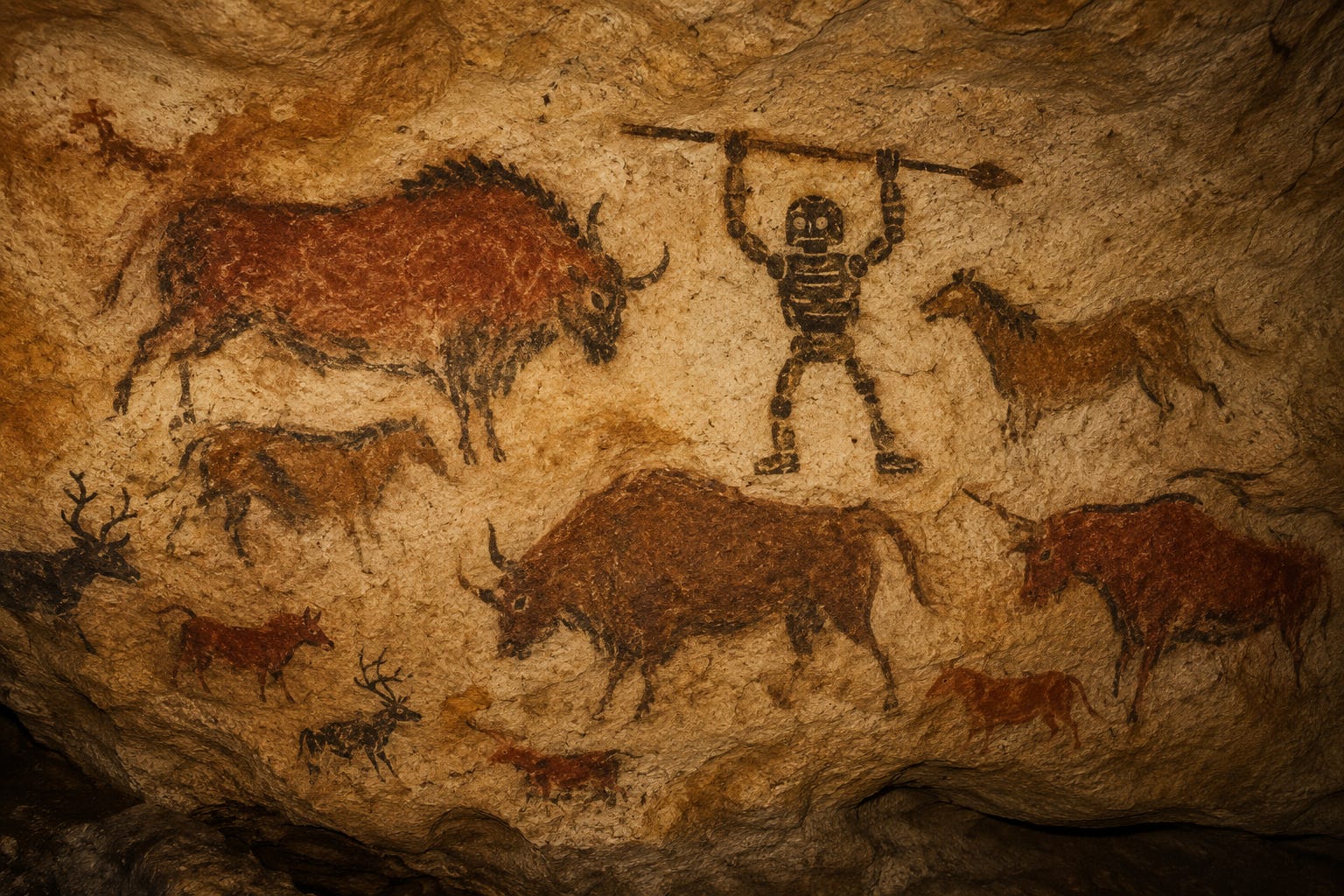
European cave paintings date roughly to 40,000-14,000 years ago, what’s called the late Paleolithic.
Homo sapiens moved into Europe around 50,000 years ago, Neanderthals died out about ten thousand years after that. Whoever created the paintings, they were anatomically modern humans.
A few other dates for perspective:
Deliberate fire-making = 400,000 BCE. These people definitely had fire.
Last glacial period = 115,000 to 10,000 BCE. Southern France was a cold, windswept tundra with a wide array of big animals. These people were skilled hunters who made use of rock shelters, but did not live deep in caves (i.e. not really “cave people.”)
Human language capacity = 135,000+ BCE. These people were not grunting at each other. They had a fully developed spoken language.
Lascaux is a network of caves in southern France featuring some of the most iconic cave paintings known. Their age is generally estimated at between 17,000 and 22,000 years.
Whoever created the paintings made use of a variety of technologies. Stone lamps which burned animal fat have been found at the site. Hollowed-out bones worked something like an airbrush. Scaffolding would have been constructed to create some of the images that are over ten feet high.
We generally talk about Lascaux and similar sites in the context of art history, with a nod toward shamanism or something like that. Cave paintings also exist as externally encoded information. The visual language and paintings themselves are technology.
Even a quick overview offers a rich database of recorded knowledge about wildlife at the time. Horses, red deer, bison, now-extinct species like the woolly rhino. The portrayals of animals and their movements are anatomically correct. One famous image includes an accurate depiction of a bison’s intestines.
Repeated symbols (circles, crosshatches, etc.) appear at multiple sites across Europe. Do they represent some form of shared graphic communication? Paleoanthropologist Genevieve von Petzinger has theorized the symbols may be a form of proto-writing, preserving concepts if not recorded language.
Even more intriguing, a recent finding by Ben Bacon in the UK seems to prove that sequences of lines and dots placed next to various animals in over 600 cave paintings across Europe correspond to the lunar months during which the animals were breeding.
Bacon, an amateur archaeologist with some academic assistance, cracked the code and revealed a Paleolithic calendar, basically blowing the doors off previous theories, and radically altering our conceptions about the kinds of information humans were recording tens of thousands of years ago.
In the A.I. world, metadata is the term for additional data that tags along with surface level information, sort of data about the data. The paintings at Lascaux are full of metadata.
Forensic archaeologists analyzing pigments have reconstructed a fairly sophisticated ancient understanding of chemistry (plant resins and animal fats were used as binders and fixatives, etc.) Many materials were sourced locally, but some were not, which tells us the creators either travelled or were part of a trade network. Either way, the Paleolithic metadata suggests the creators of the cave paintings were part of a larger sphere than the immediate surrounding area.
Another remarkable find comes from a recent dig in Zambia, where archaeologists discovered two intentionally interlocking logs—dating back 476,000 years. That means humans have been building with wood 450,000+ years longer that we’d thought.
Much like the word cavemen, the phrase stone age is a misnomer. We’ve called it the stone age because stone artifacts last, so that’s mostly what we’ve found, but that doesn’t mean stone was the only material Paleolithic people worked with.
The paintings at Lascaux were preserved thanks to sealed environments which remained stable over millennia. Imagine how many drawings and tabulations may have been etched onto wood, skins, or dirt. Paleolithic people may have been recording data constantly, but it simply hasn’t been preserved.
Cave paintings are not Paleo A.I., they don’t simulate human cognition. What they do incredibly well is preserve data, so in a sense we can see them as an early building block along the way to our current technological moment.
The paintings offer proof that our human impulse to record knowledge externally goes back at least tens of thousands of years if not further. Some theorists argue that this exosomatic urge is hardwired in our DNA.
Something to think about, particularly here at the dawning of the Brain-Computer Interface Era.
—
Sources:
Tedesco, Laura Anne. “Timeline of Art History: Lascaux.” Metropolitan Museum of Art Website, Oct. 1, 2000. https://www.metmuseum.org/essays/lascaux-ca-15000-b-c
Rott, Nathan. “Fire-Making Materials at 400,000-year-old Site Are the Oldest Evidence of Humans Making Fire.” National Public Radio. Dec. 11, 2025. https://www.npr.org/2025/12/11/nx-s1-5640109/early-humans-fire-making-oldest-discovery-archaeology
Von Petzinger, Genevieve. “The First Signs.” Simon & Schuster, New York, 2016.
Bacon, Ben et.al. “An Upper Paleolithic Proto-writing System and Phenological Calendar.” Cambridge University Press. 2023 https://www.cambridge.org/core/journals/cambridge-archaeological-journal/article/an-upper-palaeolithic-protowriting-system-and-phenological-calendar/6F2AD8A705888F2226FE857840B4FE19
Barham, L. et.al. “Evidence for the Earliest Structural Use of Wood at Least 476,000 Years Ago.” Nature. Sept. 20, 2023 https://www.nature.com/articles/s41586-023-06557-9
Edwards, H.G.M. et.al. “Raman Spectroscopic Analysis of Pigments and Substrata in Prehistoric Rock Art.” Journal of Molecular Structure. Sept. 5, 2000. https://www.sciencedirect.com/science/article/abs/pii/S0022286000003896
Newby, Gregory. “Cognitive Space and Information Space.” Journal of the American Society for Information Science and Technology. August, 21, 2001. https://onlinelibrary.wiley.com/doi/abs/10.1002/asi.1172
Prehistoric Sites and Decorated Caves of the Vézère Valley. UNESCO. https://whc.unesco.org/en/list/85/
Cave Painting Data Base: https://eoliths.org/rock-art.html
—
—
Click below for…
This is fascinating. I love this new multidimensional way of thinking about cave paintings!