
ARCHaiC 4
Everyday People

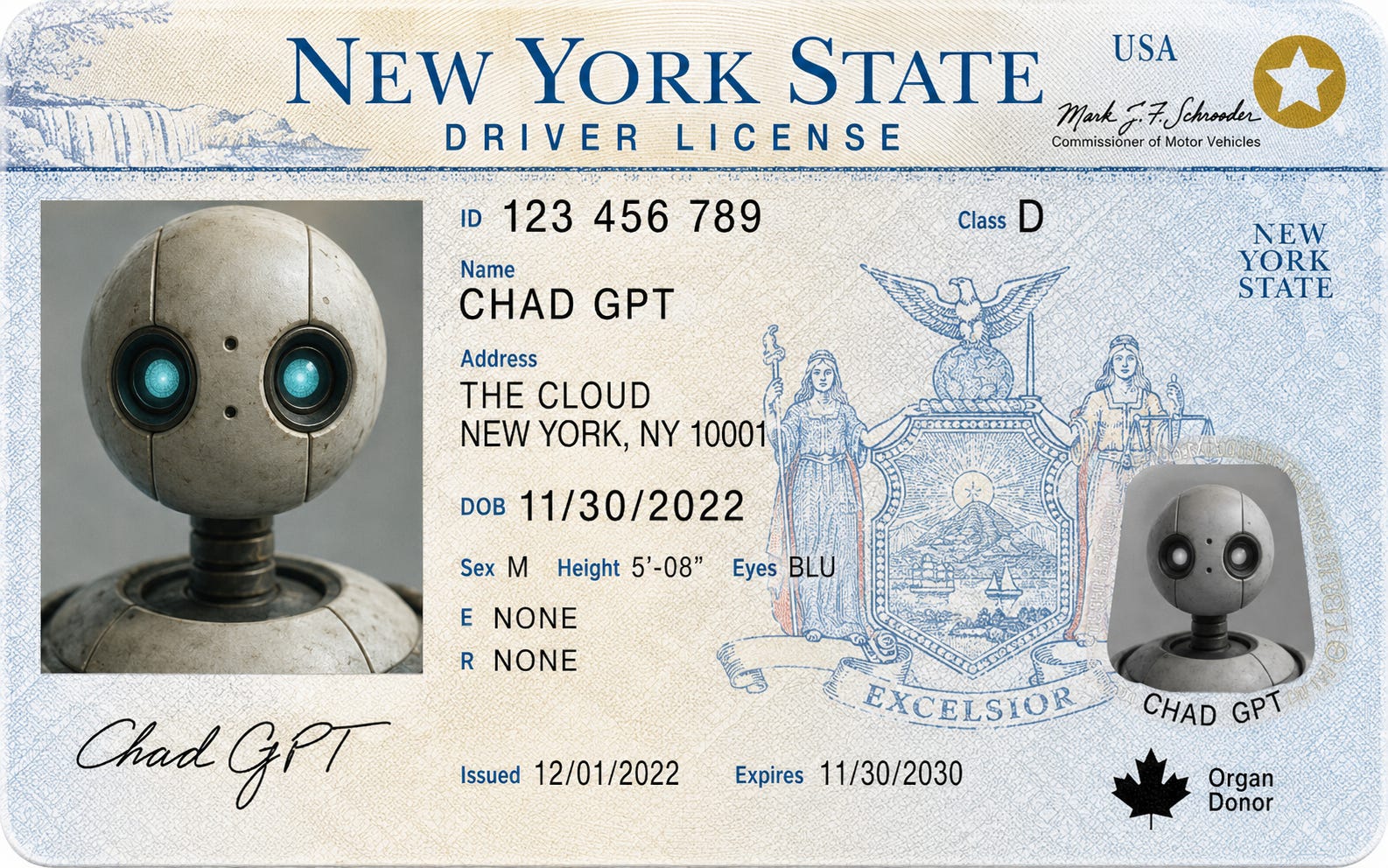
Last week, we talked about how a chatbot is not a thinking/feeling being. But that might not stop A.I. from becoming a “person.”
Some backstory:
In 1868, the Fourteenth Amendment was added to the US Constitution. The “equal protection clause” was intended to protect the rights of recently emancipated humans, but would soon be protecting the rights of something entirely different.
In the late 1870s, when California drew up its state constitution, it didn’t grant railroads one of the tax deductions it gave individual property owners. Southern Pacific took it to the Supreme Court, and won.
The case was decided on other merits, but it was noted that equal protection under the Fourteenth Amendment seemed to have been applied, establishing a legal precedent.
So, in 1886, railroad companies became “persons.”
Cut to 2010. In a fantastic display of doublespeak, it was argued before the Supreme Court that corporations were, in essence, “citizens united,” and therefore entitled the same freedoms of speech as individual citizens.
The Court ruled in favor of Citizens United, 5-4, ushering in our current age of unlimited corporate campaign financing, and solidifying the legal fiction that you don’t have to be a person to have the same rights as a person.
Will the Supreme Court soon be hearing arguments for A.I. personhood? Earlier this year, the Court let a lower court decision stand that legal authorship requires a human being. But it’s only a matter of time before a case presents itself that the Court will be compelled to hear.
Where’s this going? What would happen if A.I. attained personhood?
Using A.I. as a separate legal entity, corporations could effectively deflect liability, shield executives, and avoid fines. Similar to Citizens United, corporations would benefit, the rest of us, not so much.
Many countries, understanding this as a Pandora’s box, are actively enacting laws regulating A.I. The United States at the federal level is lagging, but at the state level the battle for A.I. regulation is quite lively.
Several states, including Idaho and Utah, have already enacted laws against A.I. “personhood.” New York State has enacted laws such as the RAISE Act which holds A.I. developers accountable for safety and transparency, but legislation concerning A.I. personhood has yet to be introduced.
The technology is evolving faster than human lawmakers’ conception of it. Even with well-intentioned legislation, there are bound to be legal loopholes.
It’s okay. A.I. will find them.
—
Sources:
Mak, Aaron. “The Case Against AI Personhood.” Politico, May 27, 2026 https://www.politico.com/newsletters/digital-future-daily/2026/05/27/the-case-against-ai-personhood-00938508
Kaste, Martin. “Several States Considering Ban On Legal Personhood For AI.” Morning Edition, NPR. May 11, 2026 https://www.npr.org/2026/05/11/nx-s1-5798754/several-states-considering-ban-on-legal-personhood-for-ai
Foreman, Conrad. “Money in Politics: Campaign Finance and Its Influence Over the Political Process and Public Policy” University of Illinois Chicago Law Review, 2018 https://repository.law.uic.edu/cgi/viewcontent.cgi?article=2781&context=lawreview
Snyder, Jason. “OpenAI: ChatGPT Wants Legal Rights. You Need The Right To Be Forgotten.” Forbes, 2025 https://www.forbes.com/sites/jasonsnyder/2025/07/27/openai-chatgpt-wants-legal-rights-you-need-the-right-to-be-forgotten/
Ghasemi, Mohammad. “AI and Corporate Personhood: A Comparative Analysis” Convergence Analysis, August 7, 2025 https://www.convergenceanalysis.org/fellowships/economics/ai-and-corporate-personhood-a-comparative-analysis
Citizens United v. Federal Election Commission (2010) https://constitutioncenter.org/the-constitution/supreme-court-case-library/citizens-united-v-fec
Thaler v. Perlmutter (2026) https://constitutioncenter.org/education/constitution-in-the-headlines/supreme-court-denies-artificial-intelligence-authorship-claim
NYS Assembly Bill A6453A, Relates to the training and use of artificial intelligence frontier models, 2025-2026 Legislative Session https://www.nysenate.gov/legislation/bills/2025/A6453/amendment/A
Governor Hochul Signs Nation-leading Legislation to Require AI Frameworks for AI Frontier Models, NYS Official Website, Dec. 19, 2025. https://www.governor.ny.gov/news/governor-hochul-signs-nation-leading-legislation-require-ai-frameworks-ai-frontier-models
Staley, Ambia. “What Would AI With Constitutional Rights Actually Look Like?” Quartz, May 2026 https://qz.com/ai-constitutional-rights-legal-personhood-implications-052726
Baab, Catherine. “The Next AI Fight: Do the Chatbots Have First Ammendment Rights?” Quartz, May 2026 https://qz.com/ai-first-amendment-rights-anthropic-claude-pentagon-regulation-law
Breaking:
Frenkel, Sheera and Swanson, Ana. “U.S. Lifts Restrictions on Anthropic’s Most Powerful A.I. Models.” NY Times, June 30, 2026. https://www.nytimes.com/2026/06/02/technology/trump-executive-order-ai.html
—
—
Click below for…
"The technology is evolving faster than human lawmakers’ conception of it."
As long as the US Secretary of Education, Linda McMahon, keeps referring to AI as A-1, what could possibly go wrong?