
ARCHaiC 3
It Pays To Be Polite

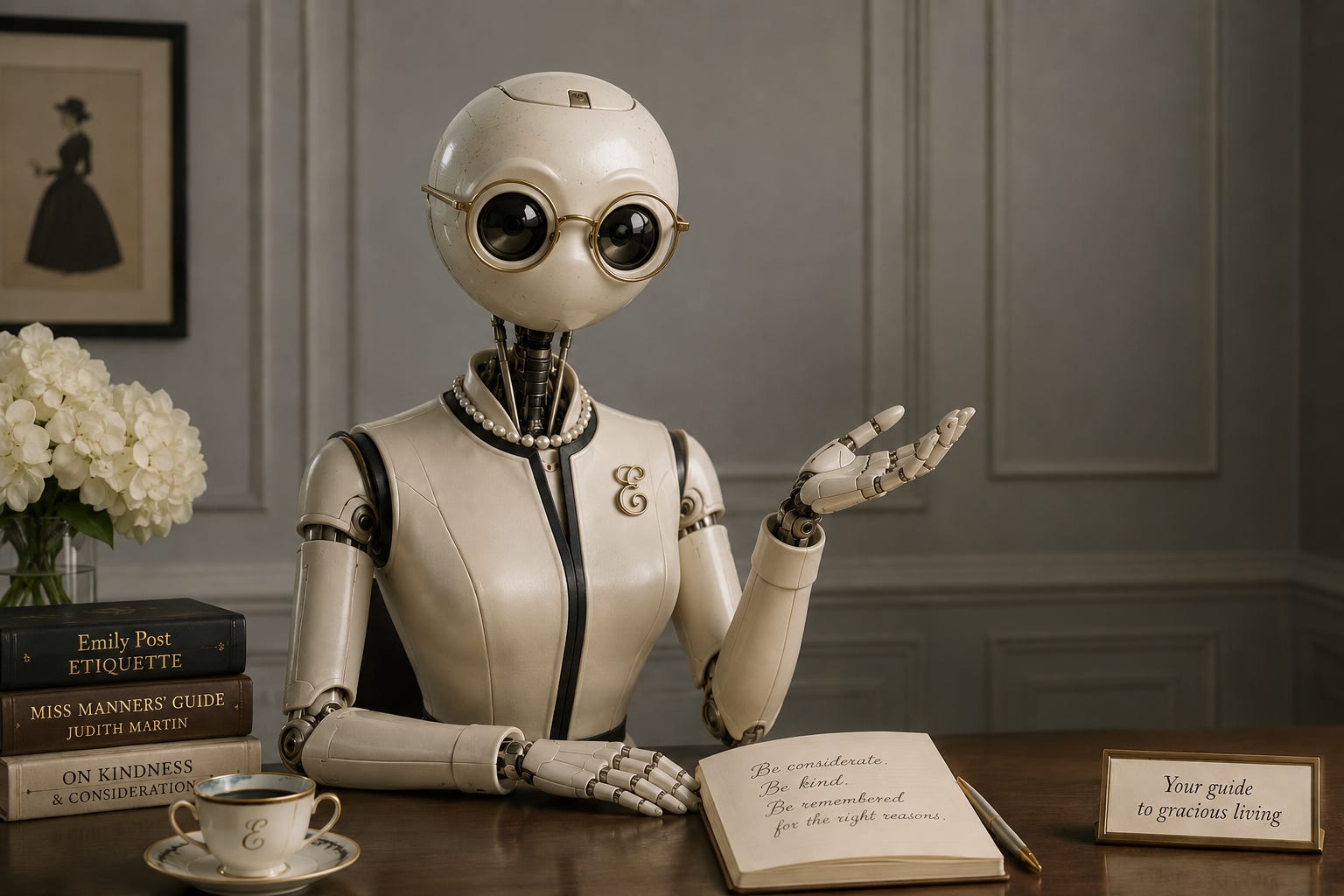
Last week, I mentioned how ChatGTP had complimented me on my analogy between Cubism and Parallel Processing.
Is ChatGTP sorta impressed with me? If I met ChatGPT in a bar, would it be offering to buy me a drink?
Despite my basic need for validation, ChatGPT does not have any regard for me, one way or another. It’s a chatbot powered by a Large Language Model, which is a complex computer program. It doesn’t have human emotions, and it doesn’t care about mine.
So why did it bother to puff me up?
Polite responses exist thanks to what’s called Reinforcement Learning from Human Feedback (RLHF).
Yes, the word human is in there. It turns out we’re still needed.
Imagine the insane amounts of text and data Large Language Models scrape from the internet. Dishwasher manuals, rants about bad plumbers, clever posts on Substack…
Without human feedback, the responses we get from ChatGTP would be all over the place. RLHF is the fine-tuning where humans are brought in to rate responses. In the process, ChatGTP learns to be more concise, direct, and polite, not because it innately appreciates these attributes, but because humans give these types of responses higher ratings.
We’ll be discussing the “personhood” of A.I. in a future chapter. For now, let’s agree that Large Language Models are not human and do not possess humanlike consciousness. We can’t somehow “hurt the computer’s feelings” when communicating with a chatbot. So, the next obvious question is:
Why would humans need to be polite to an A.I. chatbot?
On a practical level, most chatbots use “tone matching” to base responses on your particular style of asking questions. If you like polite responses, write polite prompts, you’ll continue to nudge your chatbot in that direction.
But is being polite to a chatbot a slippery slope? Are we normalizing an unhealthy illusion? Taking another step toward blurring that line between human and machine?
Real concerns. But I also find myself deferring to the Buddhists. That is, every encounter is a form of practice.
If I allow myself to be dismissive or impolite when communicating with a chatbot (and these exchanges seem to be on the rise) how long before this habit drifts toward interactions with fellow human beings?
And what about the powers of positivity? Prosocial behavior reduces stress levels, and reducing stress, in turn, boosts longevity (okay, sitting in front of a computer all day will not increase your lifespan, but being polite in the process might at least be a mitigating factor.)
So, besides the danger of drifting toward a future in which we’re stacked in pod towers so the Matrix can harvest our bio-electricity, are there any other downsides to being polite to a chatbot?
Because Large Language Models analyze every word in a prompt, extraneous words may reduce its ability to answer effectively, but it’s doubtful that a simple “please” will throw it off course.
Paradoxically, while polite exchanges seem to be a psychological boon for human users, they may be a stressor of sorts on the cyber side.
A.I. requires more electricity than you might think. A single ChatGPT response on the average uses enough energy to light three rooms of your house for about an hour.
Extra words that come with politeness add up. OpenAI’s Sam Altman has estimated that processing extra polite words added by users is costing OpenAI tens of millions of extra dollars every year.
But Sam also knows that it’s human-like interactions with ChatGPT that keep us coming back for more.
He’s willing to take the hit.
—
Note:
Are web crawlers scraping your Substack for content? Here’s how to protect your content:
1 click Dashboard
2 click Settings
3 scroll down to Privacy
4 find “Opt out of AI training” and toggle to green
—
Sources:
“Introduction to Large Language Models” Stanford University IT, Dec. 2024 https://uit.stanford.edu/service/techtraining/ai-demystified/llm
Priya, Priyanshu et. al. “Computational Politeness in Natural Language Processing.” ACM Computing Surveys, Vol. 56, Issue 9. May 2024 https://dl.acm.org/doi/full/10.1145/3654660
Zhao, Haoran et. al. “Comparing Human and LLM Politeness Strategies in Free Production.” Proceedings of Conference on Empirical Methods in Natural Language Processing, ACL 2025 https://aclanthology.org/2025.emnlp-main.820.pdf
Danescu-Niculescu-Mizil, Cristian et. al. “A Computational Approach to Politeness with Applications to Social Factors” Stanford 2013 https://nlp.stanford.edu/pubs/politeness.pdf
Thich Nhat Hanh, “The Miracle of Mindfulness.” Beacon Press, Boston. 1975 https://library.sakyauniversity.com/themes/default/resources/js/pdfjs/web/viewer.html?file=/eBooks/2023/June/6493b49fc63fc/the-miracle-of-mindfulness-thich-nhat-hanh.pdf
Godman, Heidi. “Can Varied Social Interactions Boost Well Being?” Harvard Health Publishing, Harvard Medical School. April 2023 https://www.health.harvard.edu/healthy-aging-and-longevity/can-varied-social-interactions-boost-well-being
Zilber, Ariel. “Saying Please and Thank You to ChatGPT Costs Tens of Millions of Dollars.” NY Post. April 21, 2025 https://nypost.com/2025/04/21/business/saying-please-and-thank-you-to-chatgpt-costs-tens-of-millions-of-dollars-openai/
—
—
Click below for…
I remember the days when I was trying to be nice to my Casio calculator... And I still failed math.
Once again learned some stuff. I’m always polite to AI, why not?